
Social Security Changes 2027: What’s Coming and How to Prepare
Every year, Social Security adjusts a handful of key numbers — and every year, those adjustments quietly reshape retirement budgets, paychecks, and tax bills. If you’re researching Social Security changes 2027, you’re asking the right question at the right time: this article breaks down exactly which figures change annually, how they’re calculated, what’s currently projected for 2027, and — more importantly — how to plan around them no matter what the final numbers turn out to be.
This guide is built to stay useful well beyond 2027. The five categories below repeat every single year. Once you understand how each one works, you’ll be able to interpret next year’s announcement — and the one after that — without needing a new article.
Why Social Security Numbers Change Every Year
Social Security isn’t static. Congress built automatic adjustment mechanisms into the program decades ago so it would respond to inflation and wage growth without requiring a new law every year. Two data sources drive almost everything:
- CPI-W (Consumer Price Index for Urban Wage Earners and Clerical Workers): drives the annual Cost-of-Living Adjustment (COLA).
- The National Average Wage Index (AWI): drives the taxable wage base and the earnings test limits.
The Social Security Administration (SSA) confirms the official numbers every October, based on third-quarter data from that year. Until then, any figure you see — including the ones below — is a projection, not a guarantee. That’s true this year, and it’ll be true every year going forward.
1. Cost-of-Living Adjustment (COLA)
What it is: An annual increase applied to every Social Security and SSI payment, designed to keep benefits in line with inflation.
How it’s calculated: SSA compares average CPI-W readings from Q3 of the current year to Q3 of the prior year. Whatever that percentage change is becomes next year’s COLA.
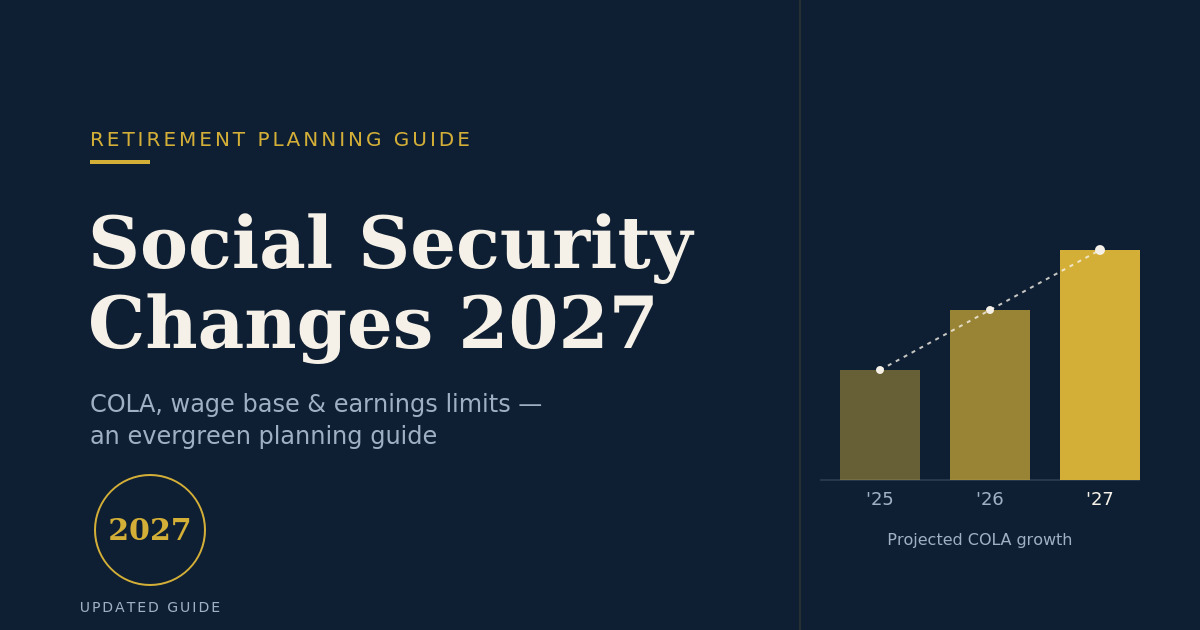
Current estimates for 2027: Projections range from roughly 2.8% to 3.8%, with independent analysts like the Senior Citizens League and Mary Johnson trending toward the higher end due to elevated energy prices. For context, the average retired worker benefit is currently a little over $2,000/month, so even a 3%–4% COLA translates to roughly $60–$80 more per month.
The evergreen takeaway: COLA size tracks inflation, not politics or program funding. In low-inflation years, expect a small bump (or occasionally none at all). In high-inflation years, expect a larger one. Budget for the low end of any early estimate, and treat anything higher as a cushion.
2. Taxable Maximum (Wage Base)
What it is: The ceiling on how much of your income is subject to the 6.2% Social Security payroll tax. Earnings above this amount aren’t taxed for Social Security — and don’t count toward your future benefit.
How it’s calculated: Tied to the National Average Wage Index, so it typically rises a few percent most years, tracking broader wage growth.
Current estimates for 2027: The 2026 Trustees Report projects the wage base rising to $190,200, up from $184,500 in 2026. The same report projects continued increases in the years after, illustrating how this figure compounds over time.
The evergreen takeaway: If you’re a high earner, this cap tends to grow every year — plan for slightly more payroll tax exposure annually. If you consistently earn above the cap, a rising wage base is actually beneficial long-term, since it raises the ceiling on what counts toward your benefit calculation.
3. Earnings Limits for Working Beneficiaries
What it is: If you claim Social Security before full retirement age (FRA) and keep working, SSA temporarily withholds part of your benefit once your earnings cross a threshold.
How it’s calculated: Two thresholds apply, both indexed to wage growth:
- Under FRA all year: $1 withheld for every $2 earned above the limit.
- The year you reach FRA: $1 withheld for every $3 earned above a higher limit (only earnings before your birthday month count).
Current estimates for 2027: The lower limit is projected to land near $25,440–$25,680 (up from $24,480 in 2026); the higher limit near $67,800–$68,400 (up from $65,160 in 2026).
The evergreen takeaway: These withholdings aren’t permanent losses. Once you hit full retirement age, SSA recalculates your benefit upward to credit back the months that were withheld. This mechanism doesn’t change from year to year — only the dollar thresholds do.
4. Medicare Premiums (The Silent Offset)
What it is: Most beneficiaries have their Medicare Part B premium deducted directly from their Social Security check, which means part of every COLA gets absorbed before it ever reaches your bank account.
Current estimates for 2027: The 2026 standard Part B premium is $202.90/month; early projections point to roughly $213/month for 2027, about a 5% increase.
The evergreen takeaway: Medicare premiums almost always rise faster than COLA in percentage terms. When estimating your “real” raise, subtract the expected premium increase from the expected COLA increase — every year, not just this one.
5. Taxation of Benefits (The Threshold That Never Moves)
What it is: Depending on your combined income, up to 85% of your Social Security benefit can be subject to federal income tax.
Why this matters more each year: The income thresholds that trigger taxation — $25,000 single / $32,000 joint for the first tier — have not been adjusted for inflation since 1983 and 1993. Because benefits rise with COLA every year but these thresholds don’t move, a larger share of retirees crosses into taxable territory annually. This is sometimes called the Social Security “stealth tax.”
The evergreen takeaway: Don’t assume your full COLA increase is tax-free spending money. If your benefit has grown for several years running, it’s worth checking whether you’ve crossed a taxation threshold — this problem only gets more common over time, not less.
Current Estimates at a Glance (2027)
| Change | 2026 (Confirmed) | 2027 (Projected) |
|---|---|---|
| COLA | 2.8% | 2.8%–3.8% |
| Taxable wage base | $184,500 | ~$190,200 |
| Earnings limit (under FRA) | $24,480 | ~$25,440–$25,680 |
| Earnings limit (year of FRA) | $65,160 | ~$67,800–$68,400 |
| Medicare Part B premium | $202.90/mo | ~$213/mo |
Official figures are confirmed by SSA in mid-October each year, based on third-quarter inflation and wage data. Treat this table as a planning estimate until then.
How to Plan When the Numbers Aren’t Final Yet
Because these figures update annually and aren’t locked in until October, the most durable strategy is a process, not a set of numbers:
- Budget off the conservative end of any early COLA estimate; treat the rest as a buffer.
- Check where your income sits relative to Medicare premium tiers (IRMAA) and benefit-taxation thresholds each year, since both can shift what you actually keep.
- If you’re working while claiming early, track your earnings against the current-year limit rather than assuming last year’s number still applies.
- Revisit your plan every October, when SSA’s official announcement replaces all projections with confirmed figures.
Bottom Line
Social Security changes every year in the same five predictable ways: a COLA tied to inflation, a rising wage base tied to wage growth, higher earnings limits for working beneficiaries, creeping Medicare premiums, and a growing exposure to benefit taxation. The specific numbers for 2027 are still projections — expect official confirmation around mid-October 2026 — but the underlying mechanics described here will still be accurate for 2028, 2029, and beyond. Bookmark this framework, not just the numbers.
Frequently Asked Questions
When will the official 2027 Social Security numbers be announced?
The SSA typically announces the COLA and related figures in mid-October, based on September inflation data. For the 2027 cycle, expect the announcement around October 14–15, 2026.
Why isn’t the 2027 COLA confirmed yet?
The COLA formula requires Q3 (July–September) CPI-W data for the current year, which the Labor Department doesn’t finish publishing until early-to-mid October. Nothing can be finalized before then.
Will my Social Security check actually go up by the full COLA percentage?
Not necessarily. If you’re enrolled in Medicare Part B, your premium is deducted directly from your check, and premiums typically rise each year too — so your net increase is usually smaller than the headline COLA.
Do these changes affect Social Security Disability Insurance (SSDI) and SSI recipients too?
Yes. COLA applies to SSDI and SSI payments the same way it applies to retirement benefits. The earnings limits and taxable wage base are more specific to retirement-age workers and current wage earners, respectively.
Is Social Security running out of money because of these changes?
These annual adjustments (COLA, wage base, earnings limits) are separate from the program’s longer-term solvency outlook, which is driven by demographic and funding trends discussed in the SSA Trustees’ annual report. Adjusting these figures is routine and doesn’t by itself indicate a funding crisis.
What’s the easiest way to estimate my 2027 benefit?
Take your current monthly benefit and multiply it by the low end of the COLA estimate (around 1.028) for a conservative projection, then subtract your expected Medicare premium increase to estimate your real take-home change.