
Ask anyone considering an MBA what it costs, and they’ll quote you a tuition number. $60,000. $120,000. $200,000 for the big names. That’s the number on the brochure — and it’s also the least useful number you’ll see in this whole decision.
Tuition is maybe 40% of what an MBA actually costs you. The other 60% hides in interest payments, lost paychecks, and opportunity cost — and that’s exactly where online and traditional MBAs diverge the most. So let’s calculate the real cost of each, not just the sticker price.
The Visible Costs
Traditional, full-time MBA (top-20 programs): $120,000–$220,000 in tuition alone, plus GMAT/GRE prep and application fees that can run $2,000–$5,000 across multiple schools. Add relocation if the program isn’t in your current city, and housing near a top campus for two years, which can easily add another $20,000–$40,000.
Online MBA: $25,000–$90,000 depending on the school, with many programs now waiving GMAT/GRE requirements entirely for applicants with a few years of work experience. No relocation, no new housing, and often no change to your day-to-day life at all beyond evenings and weekends.
On paper, online already looks cheaper. But tuition is where the easy math ends — and where most comparison articles stop, which is exactly why they’re misleading.
The Hidden Costs — Where the Real Gap Opens Up
1. Lost income
A full-time traditional MBA usually means two years out of the workforce. If you’re earning $70,000 a year before business school, that’s $140,000 in forgone salary — before you’ve paid a cent of tuition. An online MBA, done while working, keeps that income flowing the entire time. This single factor is often larger than the tuition difference between the two formats, and it’s the number almost nobody puts in their decision spreadsheet.
2. Loan interest, compounded
Few people pay MBA tuition in cash. Say you borrow $150,000 for a traditional MBA at 7% interest over a 10-year repayment term — you’ll pay back close to $210,000 total once interest is factored in. Borrow $50,000 for an online MBA at the same rate, and you’re repaying around $70,000. That’s a $140,000 gap in interest alone, stacked on top of the principal difference.
If you’re financing this with an education loan, the loan’s structure matters just as much as its headline rate — fixed vs. variable terms, prepayment penalties, and grace periods can swing your total cost by tens of thousands of dollars on their own.
3. Recruiting pipeline access
This is where traditional MBAs can claw some value back. Top full-time programs have on-campus recruiting relationships with consulting firms, investment banks, and Fortune 500 leadership programs that are genuinely hard to access any other way. If your goal is a career pivot — say, engineering into consulting, or operations into private equity — that pipeline can be worth real money in ways a spreadsheet undersells.
Online programs are closing this gap fast, with virtual recruiting events and alumni networks that increasingly rival campus programs. But for the most competitive pivots, it’s not yet equal, and pretending otherwise does readers a disservice.
4. Opportunity cost of time, not just money
Two years is two years. If you’re 28, that’s two years of career growth, promotions, and compounding experience you don’t get back. An online MBA lets you keep climbing your current ladder while you study — accumulating raises, tenure, and responsibility — which matters more if you’re not trying to change industries entirely.
There’s also a quieter cost here: two years of your network staying exactly where it is, versus two years of it actively growing inside your current company while you study part-time.
The Real Cost Table
5-year total cost: tuition + loan interest + lost income (assuming a $70,000 pre-MBA salary and a 7% loan rate)
| Program Tier | Traditional MBA | Online MBA |
|---|---|---|
| State school | $90,000 tuition + $35,000 interest + $140,000 lost income = $265,000 | $30,000 tuition + $12,000 interest + $0 lost income = $42,000 |
| Mid-tier private | $150,000 tuition + $58,000 interest + $140,000 lost income = $348,000 | $55,000 tuition + $22,000 interest + $0 lost income = $77,000 |
| Top-20 program | $200,000 tuition + $78,000 interest + $140,000 lost income = $418,000 | $85,000 tuition + $33,000 interest + $0 lost income = $118,000 |
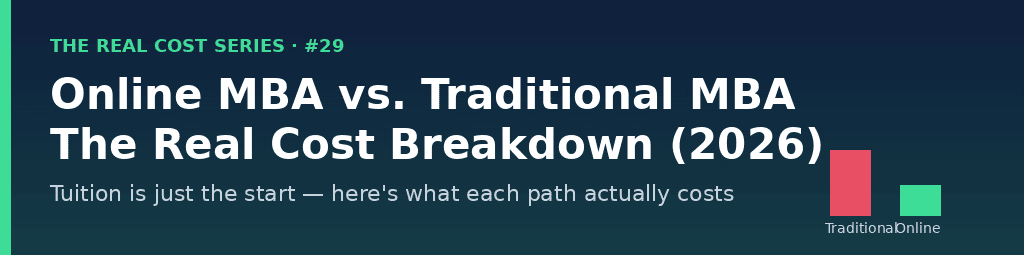
The gap isn’t 2x. At the top end, it’s closer to 3.5x — and most of that gap is lost income and interest, not tuition. That’s the number worth sitting with before you fill out any application.
Who Actually Comes Out Ahead
Online MBA wins if:
- You’re a working professional looking to advance within your current field
- You can’t or don’t want to pause your income for two years
- You’re self-funding, or debt-averse, and want to minimize interest exposure
- Your target role doesn’t require a specific brand-name pedigree to break in
Traditional MBA can still win if:
- You’re switching industries entirely and need the recruiting pipeline
- You’re early enough in your career that two years of opportunity cost is genuinely cheap
- The specific program’s brand name opens doors that are otherwise closed to you — true mainly for a handful of top-10 schools, not the broader “traditional vs. online” category
For most people reading this — especially if you’re already weighing an education loan for grad school — the online route’s math is hard to argue with unless the career-pivot case applies directly to you. Run your own numbers before you sign anything: your current salary, your target loan rate, and the specific program’s actual tuition, not the sticker price on the homepage.
If you’re financing either path, see our breakdown on education loans before you borrow — the loan’s structure often matters more than the rate you’re quoted.
FAQ: Online MBA vs Traditional MBA
Does an online MBA look bad to employers?
Less than it used to. As of 2026, most major employers — including consulting firms and Fortune 500 companies — treat accredited online MBAs from reputable business schools the same as their on-campus equivalents, especially for internal promotions. The bias that existed a decade ago has faded significantly as online programs from top-ranked schools (many run by the same faculty as their full-time programs) have become mainstream. The exception is still ultra-competitive, brand-driven industries like investment banking and elite consulting, where the specific school’s full-time recruiting pipeline still carries more weight than the degree format itself.
Is a cheaper online MBA actually worth less?
Not necessarily — and this is one of the biggest misconceptions in the comparison. Price often reflects the format (lower overhead for the school, no campus costs passed to students) rather than program quality. Many online MBAs are run by the exact same faculty, using the exact same curriculum, as the traditional program at the same school. Check accreditation (AACSB is the gold standard) and whether the online degree is explicitly the same credential as the on-campus one — some schools do issue a different, lesser credential for online tracks, which is worth ruling out before enrolling.
Can I get financial aid or loans for an online MBA?
Yes. Accredited online MBA programs qualify for the same federal and private loan options as traditional programs in most countries, including education loans designed for international students. Because online MBA tuition is typically lower, your total loan amount — and the interest that compounds on it — ends up significantly smaller too, which is the core math this whole article is built around.
How long does an online MBA actually take?
Most online MBAs run 18–36 months part-time, compared to 21–24 months for a full-time traditional program. It’s often longer in calendar time, but because you’re working throughout, the opportunity cost is far lower than the traditional path’s two-year income gap.
Which is better for an international student or NRI professional?
It depends heavily on visa status and career goals. If you’re studying in the country where you plan to work and need visa sponsorship tied to a full-time program, traditional often wins by necessity, not just preference. If you’re already working (including remotely for an employer back home) and want to upskill without disrupting your visa or income, an online MBA from an accredited program is usually the stronger financial move — you avoid both the lost-income gap and the complexity of a student visa transition.