
5V 1A vs 5V 2A Charger: Which One Should You Actually Use?
If you’ve ever flipped over a phone charger or power brick, you’ve probably noticed a tiny label like “5V 1A” or “5V 2A” stamped near the plug. Most people ignore it completely — until their phone starts charging painfully slowly, or worse, they plug in the wrong adapter and start wondering if they just damaged their device.
Here’s the good news: understanding these two numbers takes about two minutes, and once you get it, you’ll never buy the wrong charger again.
What Do the Numbers Actually Mean?
Every charger label follows the same format: volts (V) × amps (A). Think of it like water flowing through a pipe.
- Voltage (V) is like water pressure — how hard the electricity is being pushed.
- Amperage (A) is like the width of the pipe — how much electricity can flow through at once.
Both a 5V 1A charger and a 5V 2A charger push electricity at the same pressure (5 volts). The difference is in the pipe width — the 2A charger can carry twice as much current as the 1A charger.
The Real Difference: Wattage
Volts and amps alone don’t tell the full story — what actually charges your device is wattage, calculated with a simple formula:
Watts = Volts × Amps
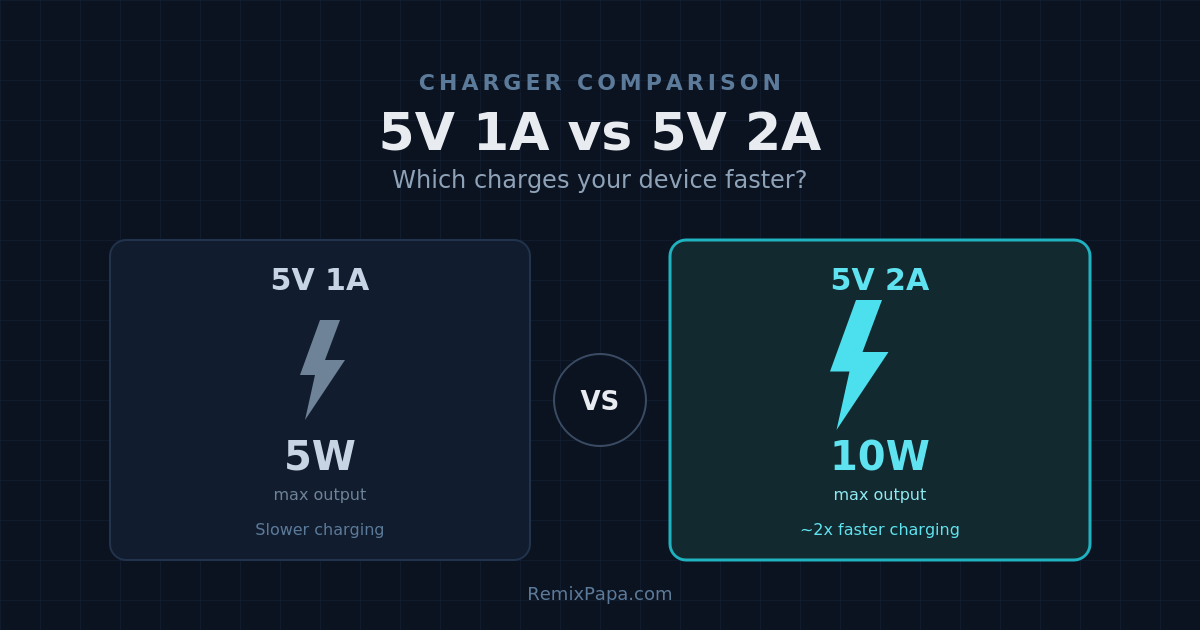
- 5V × 1A = 5 watts
- 5V × 2A = 10 watts
That means a 5V 2A charger delivers exactly double the power of a 5V 1A charger. In practical terms, a device plugged into the 2A charger will fill up noticeably faster — assuming the device itself is built to accept that much power.
Quick Comparison Table
| 5V 1A Charger | 5V 2A Charger | |
|---|---|---|
| Voltage | 5V | 5V |
| Current | 1 Amp | 2 Amps |
| Max Wattage | 5W | 10W |
| Charging Speed | Slower | About 2x faster |
| Best For | Older phones, small gadgets, e-readers | Modern smartphones, tablets |
| True “Fast Charging”? | No | No |
Is 5V 2A Considered “Fast Charging”?
Here’s where a lot of confusion comes from: neither of these is true fast charging. Real fast-charging standards (like USB Power Delivery or Quick Charge) start at 9 volts and roughly 18 watts or higher — nearly double what even a 5V 2A charger can produce.
So while a 2A charger is meaningfully faster than a 1A one, don’t expect it to fill your phone from empty to full in 30 minutes. For that, you’d need a charger and cable that both support a higher-voltage fast-charging protocol, plus a phone that supports the same standard.
Which One Should You Use?
- Use a 5V 1A charger for: basic Bluetooth speakers, e-readers, older feature phones, smartwatches, and other low-power accessories that don’t need much energy to top up.
- Use a 5V 2A charger for: modern smartphones, tablets, and most everyday devices — it’s become close to the standard minimum for reasonably fast phone charging.
If you’re not sure which your device needs, check the fine print on the original charger it came with, or look in the device’s settings/manual for its rated input.
Can Using the “Wrong” One Damage Your Device?
Generally, no — and this trips people up. Modern devices are built to only pull as much current as they actually need, regardless of what the charger is capable of supplying. So:
- Plugging a phone that wants 2A into a 1A charger won’t damage it — it’ll just charge more slowly.
- Plugging a low-power device into a 2A charger won’t overload it either — the device simply draws less current than the charger can provide.
The bigger risk isn’t voltage mismatches within the same standard — it’s using chargers with the wrong voltage entirely (like plugging a laptop-rated charger into something that only expects phone-level voltage) or using cheap, uncertified cables and bricks that don’t regulate power properly.
A Common Mistake: Assuming All USB-C Chargers Are Interchangeable
Because so many devices now share the same USB-C connector, it’s easy to assume any USB-C charger works for any USB-C device. In reality, a phone charger and a laptop charger might both use USB-C but deliver wildly different power levels — phone chargers often top out well below what a laptop needs to charge properly, even if the plug fits. Matching connector shape isn’t the same as matching power output.
Bottom Line
A 5V 2A charger delivers double the wattage of a 5V 1A charger (10W vs 5W), which means noticeably faster charging for compatible devices — though neither qualifies as genuine fast charging. For most modern phones and tablets, a 2A (or higher) charger is the better everyday choice. For small, low-power accessories, a 1A charger works just fine and won’t overwork the device.
When in doubt, match the charger to what your device’s manufacturer recommends — that’s the safest way to get reliable charging speed without any guesswork.
FAQs
Can I use a 5V 2A charger on a device that came with a 5V 1A charger? Yes. The device will only draw the current it needs, so it’s safe — it just won’t charge any faster than the device is designed to accept.
Will a 5V 1A charger damage a device that needs 2A? No, but it will charge slower than the device is capable of.
Is 2A always faster than 1A in real-world use? Only if the device itself supports drawing 2A. If it’s limited to 1A internally, using a 2A charger won’t speed anything up.
What’s better than 5V 2A for fast charging? Look for chargers and devices that support USB Power Delivery (PD) or Quick Charge — these operate at higher voltages (9V, 12V, 20V) for genuinely faster charging.