
The Real Cost of Renting to Own Furniture or Electronics
You walk into a rent-to-own store with no credit check, no down payment, and a payment that fits comfortably into your weekly budget. A full living room set for $30 a week feels manageable. A laptop or TV for $20 a week feels almost painless. What most customers don’t calculate until months later is what that “manageable” payment adds up to — and how dramatically it compares to simply buying the item outright, even with a mediocre credit card.
This is the real cost of rent-to-own: not the weekly number on the sign, but the total you’ll actually pay by the time you own the item — if you ever do.
How Rent-to-Own Is Structured (And Why It’s Not Called a Loan)
Rent-to-own (RTO) agreements are legally structured as a series of renewable weekly or monthly leases, each with an option to buy, rather than as a loan or installment sale. That distinction matters more than it sounds. Because RTO contracts are leases, they aren’t required to disclose an interest rate the same way a credit card, personal loan, or auto loan must under federal truth-in-lending rules.
That single structural choice is why rent-to-own can charge what amounts to a very high interest rate without ever printing the words “interest rate” anywhere on the agreement.
What the Effective APR Actually Looks Like
When consumer researchers convert RTO weekly payments into an equivalent annual percentage rate, the numbers are far higher than what most people would knowingly agree to. Surveys of rent-to-own stores have found effective APRs commonly landing between 100% and 370%, depending on the item and the store — compared to roughly 20-30% for even a high-interest credit card.
Separately, government and consumer-advocacy reviews have documented individual cases where customers paid $1,000 to $2,400 in total for a television or appliance that would have retailed new for as little as $200 to $600. Broader analysis of the industry has consistently found that total rent-to-own payments run two to three times the retail price of an item — and sometimes considerably more.
Why the Markup Exists
To be fair to the industry, not all of that markup is pure profit. Rent-to-own companies are covering real costs that a standard retailer doesn’t carry:
- No credit check and no down payment — the store is taking on default risk that a bank would price into a loan approval process instead.
- Free delivery, setup, and repairs — bundled into every agreement, not billed separately.
- High return rates — only around a quarter of RTO agreements are estimated to end in full ownership; returned items need refurbishing before they can be rented again, and that cost gets spread across every customer’s price.
The problem isn’t that RTO companies charge for these services — it’s that most customers don’t realize they’re paying finance-level rates for them, because nothing labeled “interest” ever appears on the paperwork.
Who Rent-to-Own Actually Serves
This isn’t a fringe product. National survey data on rent-to-own customers shows the typical user skews toward lower household income, with a majority earning under $25,000 a year and most having a high school education or less. That context matters for a “real cost” analysis: the people paying the highest effective interest rates in the consumer marketplace are frequently the ones who can least afford to lose that money.
It’s also worth noting that most people who start a rent-to-own agreement do intend to buy the item, and a majority of RTO merchandise is, in fact, eventually purchased rather than returned. In other words, most customers aren’t using RTO as a short-term rental — they’re using it as financing, whether they think of it that way or not.
A Worked Example: The $300 Television
Numbers make this concrete faster than percentages do.
| Path | Total Cost | Time to Own |
|---|---|---|
| Pay cash at retail | $300 | Immediate |
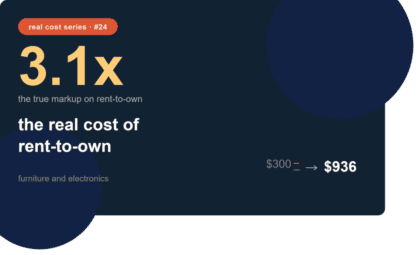
| Rent-to-own at ~$18/week for 52 weeks | ~$936 | 12 months |
| 0% intro-APR store financing, paid off in 12 months | $300 | 12 months |
| Basic secured credit card at 25% APR, paid off in 12 months | ~$340 | 12 months |
The weekly rent-to-own payment ($18) looks almost identical to a phone bill. The annual total is over three times the sticker price of the TV — and more than double what even a fairly expensive credit card would have cost for the exact same timeline.
Cheaper Ways to Get the Same Item
- 0% or low-APR store financing, paid off inside the promotional window, keeps your total cost at or near the retail price.
- A secured or starter credit card, used only for the one purchase and paid down steadily, costs a fraction of RTO’s effective rate even at a punishing APR.
- Marketplace and resale platforms — Facebook Marketplace, OfferUp, local thrift and furniture resale stores — often have the same category of item, used but functional, for 10-30% of retail price.
- Layaway programs, still offered by some retailers, let you pay over time with zero interest and no risk of losing money you’ve already paid if your plans change.
- Local nonprofit and community assistance programs specifically help with furniture and appliance needs, especially for people rebuilding after a move, house fire, or difficult transition — worth a search before signing any RTO agreement.
The Bottom Line
Rent-to-own isn’t fraudulent — it’s a fully legal, disclosed option that can genuinely help someone who needs an item today and has no other access to credit. But “no credit check” and “an affordable weekly payment” are marketing language for what is, mathematically, one of the most expensive ways to acquire furniture or electronics anywhere in the consumer market. If you can wait even a few weeks to save, or qualify for even a mediocre-APR credit option, the same item will almost always cost you less than half of what rent-to-own will — sometimes a third.

FAQs
1. Is rent-to-own the same as a loan?
No. Legally, RTO agreements are structured as renewable leases with a purchase option, not as loans or installment sales. That’s why they aren’t required to disclose an interest rate, even though the effective cost of borrowing is often far higher than a typical loan.
2. What’s the average interest rate on a rent-to-own agreement?
There’s no stated interest rate, but when researchers calculate the effective annual percentage rate based on total payments versus retail price, it commonly falls between 100% and 370%, depending on the item and retailer.
3. Do most people who rent-to-own actually end up owning the item?
Yes, more often than not. Survey data shows a majority of RTO merchandise is eventually purchased by the customer, meaning most people are effectively financing the item over time rather than renting it short-term.
4. Why does rent-to-own cost so much more than buying outright?
The price covers more than the item itself — no credit check, free delivery and setup, and repairs during the rental period are all bundled in, along with the cost of refinishing items that are returned unpurchased. But the markup still typically far exceeds what those services would cost separately.
5. What’s a better alternative to rent-to-own if I have bad credit?
Store financing with a 0% introductory rate, a secured credit card paid off quickly, layaway programs, or buying used through marketplace platforms are all typically far cheaper than RTO, even for people who can’t qualify for standard financing.