
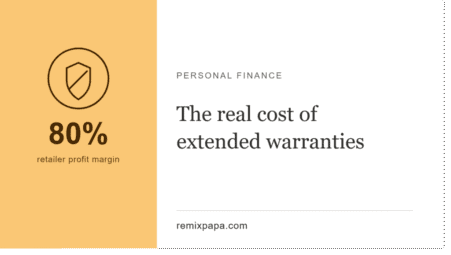
The Real Cost of Paying for Extended Warranties
You’re at checkout — a new TV, a laptop, a car — and the cashier or finance manager asks the question: “Would you like to add protection?” It sounds cheap next to the price of the item itself, and it sounds smart. Nobody wants to be the person who skipped coverage and then paid full price for a repair. What the pitch doesn’t mention is that the entire business model of extended warranties depends on most buyers never using them.
The Business Model, in One Number
Extended warranties are some of the most profitable products retailers sell — not because they’re expensive to provide, but because they’re rarely claimed. Consumer Reports’ own finance editor has said profit margins on extended warranties run as high as 40% to 80%, and a separate industry analysis found some contracts carrying margins in excess of 200%. For comparison, margins on the actual physical products being covered often run closer to 10%.
That gap isn’t hidden by accident. During one notable year, extended warranty sales accounted for nearly all of Circuit City’s operating income and about half of Best Buy’s — meaning for some retailers, the “protection plan” you’re offered at checkout wasn’t a side add-on, it was close to the core of the business.
How Often Do People Actually Use Them?
Across multiple independent surveys, the pattern is consistent: most people who buy an extended warranty never file a claim on it.
- A Consumer Reports survey found more than half of extended auto warranty purchasers never used their policy at all, and those who did still spent hundreds more on the contract than they recouped in repairs.
- A separate Consumer Reports auto warranty survey found 65% of respondents spent significantly more on the warranty than they got back — with an average loss of $300 per buyer, and only 20% coming out ahead.
- A poll by Angie’s List found 61% of members had bought an extended warranty of some kind, and half of those who did said they never used it.
- For consumer electronics specifically, the Consumer Electronics Association found only about 20% of buyers who purchased an extended warranty ever used the service.
Why the Warranty Rarely Pays Off
The math against you isn’t random — it’s by design, and it comes down to when products actually break.
Most product failures happen in one of two windows: almost immediately (within the first 90 days, often still covered by the manufacturer) or well after a typical 2-4 year extended warranty period has already expired. One industry analyst put it bluntly: most consumer electronics returns happen within the first month of ownership — squarely inside the free manufacturer warranty, before an extended plan even matters.
For major appliances, reliability data shows the likelihood of needing a repair within the first three years is often under 10% for common items. Buying multi-year protection on something with a single-digit failure rate is, statistically, a bet you’re likely to lose.
A Worked Example: The New Car Warranty
Take the extended auto warranty numbers directly from a large Consumer Reports survey:
| Outcome | Share of buyers | Average result |
|---|---|---|
| Never used the warranty at all | 42% | Full cost lost |
| Used it, but spent more on the warranty than they saved | ~43% | Average $300 net loss |
| Came out ahead | 20% | Modest net savings |
The median warranty cost in this survey was around $1,000, with an average benefit of $700 — a $300 loss for the typical buyer. Even among owners of less reliable, more repair-prone brands, only about a third came out ahead financially.
When an Extended Warranty Can Actually Make Sense
This isn’t a blanket “never buy one” — there are narrower cases where the math shifts:
- Items with historically high failure rates or short original coverage — some experts point to treadmills and other items with under two years of standard parts coverage as a plausible exception.
- Laptops, where accidental damage (not just mechanical failure) is a real and common risk, and where an extra year or two of coverage can be reasonably priced relative to replacement cost.
- Known unreliable brands or models — if a specific make has a documented pattern of expensive failures just outside the standard warranty window, the odds shift closer to even.
For the vast majority of everyday electronics and appliances, though, the data consistently favors skipping it.
What to Do Instead of Buying the Warranty
- Self-insure: put the amount the warranty would have cost into a dedicated savings account instead. Across enough purchases over time, you’ll almost always come out ahead of buying every warranty offered, since most items never need the coverage at all.
- Check what you already have: many credit cards automatically extend the manufacturer’s warranty by an extra year for purchases made on that card, at no additional cost.
- Know the return-window math: since most failures happen either immediately or well outside the extended warranty period, a longer manufacturer return window or a slightly better original warranty (worth checking before you buy the product) often matters more than the add-on plan.
- Negotiate it down or walk away: extended warranty pricing has enormous margin built in — asking for a lower price, or simply declining at checkout, costs you nothing and is rarely the moment that determines whether you can get the item at all.
The Bottom Line
Extended warranties are sold on fear of an expensive repair, but the data says the far more common outcome is paying for coverage you never use. With profit margins running as high as 40-80% and the majority of buyers in survey after survey losing money on the deal, the extended warranty pitch at checkout is one of the clearest examples in everyday retail where the “safe” choice is statistically the losing one.

FAQs
Q1: Are extended warranties worth buying?
A1: For most products, no — surveys consistently show 42-65% of buyers never use their extended warranty at all, and those who do typically spend more on the warranty than they recover in repair savings.
Q2: Why are extended warranty profit margins so high?
A2: Because they’re rarely claimed. Consumer Reports has cited margins of 40-80% on extended warranties, compared to roughly 10% margins on the products themselves, since retailers collect the full price upfront but pay out on only a fraction of contracts sold.
Q3: When does an extended warranty actually make financial sense?
A3: Mainly for products with historically high failure rates just outside standard coverage, or items with real accidental-damage risk like laptops. For typical electronics and appliances with low three-year failure rates, the odds usually favor skipping it.
Q4: Does my credit card already cover extended warranty protection?
A4: Many credit cards automatically extend a manufacturer’s warranty by an additional year at no extra cost — worth checking before paying for a separate plan on the same purchase.
Q5: What should I do instead of buying an extended warranty?
A5: Consider self-insuring by setting aside the warranty’s cost in savings instead; across multiple purchases over time, most people come out ahead this way since the majority of items never need a covered repair.
Disclaimer: This article is for general informational and educational purposes only and does not constitute financial advice. Extended warranty terms, coverage, and value vary significantly by product, retailer, and brand reliability. Before declining or purchasing a warranty, review the specific contract terms and consider your own product’s reliability history. RemixPapa.com is not responsible for financial decisions made based on this content.