
Debt Consolidation Loan: Calculator, Costs & Risks
I’ve updated the article below and kept country-specific claims conservative. The CFPB currently notes that consolidation can simplify payments but may cost more overall if the term is extended or fees are added. Consumer Financial Protection Bureau+1
Debt Consolidation Loan: How It Works, Calculator, Costs and Risks
Managing several credit cards, personal loans, or other debts can become difficult when every account has a different payment date, interest rate, and balance.
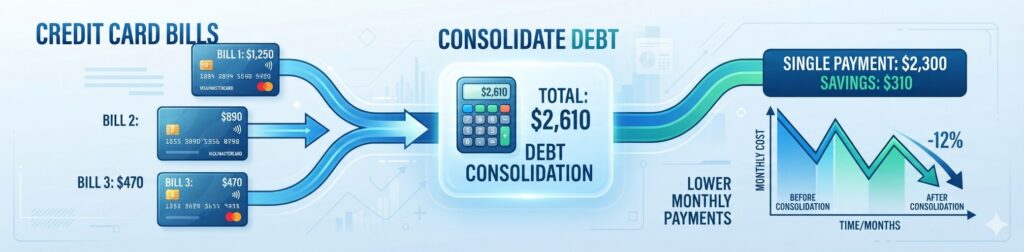
A debt consolidation loan can combine multiple debts into one new loan, allowing you to replace several payments with one monthly payment.
But consolidation does not make debt disappear. The new loan could reduce your interest cost in some situations, but a longer repayment period, fees, or a higher interest rate could make the total cost higher.
This guide explains how debt consolidation loans work, how to compare them, and what borrowers in the United States, Canada, United Kingdom, Australia, and India should consider before applying.
What Is a Debt Consolidation Loan?
A debt consolidation loan is a new loan used to repay multiple existing debts.
For example, you might have:
- Two credit card balances
- A personal loan
- A consumer loan
- Another high-interest debt
Instead of making several payments every month, you may use a new loan to pay those balances and then make one payment toward the consolidation loan.
The Consumer Financial Protection Bureau says debt consolidation can combine debts into one payment, but borrowers should consider interest rates, fees, repayment periods, and the possibility of paying more overall. Consumer Financial Protection Bureau
The main potential benefit is simplification. Depending on the terms, consolidation may also reduce the interest rate.
Debt Consolidation Loan Calculator
Before applying for a consolidation loan, calculate the approximate monthly payment and total repayment.
You can use this basic formula:
Monthly payment = P × r × (1 + r)ⁿ ÷ [(1 + r)ⁿ − 1]
Where:
- P = loan amount
- r = monthly interest rate
- n = number of monthly payments
For example, if you consolidate $20,000 at an annual interest rate of 10% for five years, the estimated monthly payment is about $425 before any additional fees.
The exact amount offered by a lender can differ because lenders may use different rates, fees, and loan terms.
What Should You Calculate?
Don’t only calculate the monthly payment.
Compare:
Current debts
- Total balances
- Current interest rates
- Monthly payments
- Remaining terms
- Early repayment or settlement charges
New consolidation loan
- Loan amount
- Interest rate or APR
- Monthly payment
- Repayment period
- Origination or processing fees
- Early repayment charges
- Total repayment
The most important number is often the total amount you will pay before the debt is completely repaid.
Debt Consolidation Loan Calculator
Estimate your monthly payment, total repayment, and total interest.
This calculator provides estimates for educational purposes only. Actual loan payments may vary because of lender rates, fees, taxes, insurance, and other charges.
How Does Debt Consolidation Work?
The process usually looks like this.
1. List all your debts
Write down every debt you want to consolidate.
Include the current balance, interest rate, monthly payment, and remaining term.
2. Calculate your current cost
Estimate how much you would pay if you continued with your existing debts.
This gives you a baseline for comparison.
3. Compare consolidation options
Depending on your country and circumstances, possible options can include:
- Personal loans
- Balance-transfer credit cards
- Secured loans
- Home-equity borrowing
- Refinancing products
- Other lender-specific consolidation products
The products available in India are not necessarily the same as those available in the United States, Canada, the UK, or Australia.
4. Compare the complete cost
Don’t choose a loan based only on an advertised interest rate.
Check the rate, fees, term, monthly payment, and total repayment.
5. Repay the old debts
If you proceed, the new borrowing is used to pay eligible existing debts.
You then make payments according to the new loan agreement.
When Can Debt Consolidation Make Sense?
Consolidation may be worth considering when the new arrangement genuinely improves your financial situation.
For example, it may help when:
- The new borrowing has a lower overall cost.
- You can comfortably afford the payment.
- Several debts can be replaced with one manageable payment.
- The fees are reasonable.
- The repayment period is appropriate.
- You have a plan to avoid accumulating additional debt.
However, the CFPB warns that a lower monthly payment can sometimes result from extending the repayment period, which can increase the total amount paid. Consumer Financial Protection Bureau
Why a Lower Monthly Payment Isn’t Always Better
Suppose you have $20,000 of existing debt.
A new consolidation loan might reduce your monthly payment from $500 to $350.
At first, that sounds like a major improvement.
But what if the original debt would have been paid off in four years while the new loan takes seven years?
You could have more cash available each month but pay interest for a much longer period.
That’s why you should ask two questions:
How much will I pay each month?
and
How much will I pay altogether?
The second question is often overlooked.
Debt Consolidation in India
Debt consolidation is also relevant to Indian borrowers who have multiple credit-card balances, personal loans, or other forms of consumer debt.
Indian borrowers may encounter personal-loan refinancing, balance-transfer products, and other lender-specific options.
However, interest rates, processing fees, foreclosure charges, eligibility criteria, documentation, and other terms vary by lender and product.
Before applying for a financial product in India, check the lender’s current official terms and applicable regulatory information rather than relying on an old article or advertisement.
For an Indian borrower, it can be useful to compare the existing EMIs with the proposed new EMI while also calculating the total interest and fees.
A lower EMI by itself does not prove that consolidation is cheaper.
Debt Consolidation in the United States
In the US, borrowers may consider personal debt-consolidation loans, balance transfers, credit counseling, or secured borrowing.
The CFPB notes that balance-transfer offers may have promotional periods and fees, while consolidation loans can sometimes have lower rates but may cost more overall if the repayment period is extended. Consumer Financial Protection Bureau
US borrowers should also be careful when a company advertises “debt consolidation” but is actually offering debt settlement.
Debt settlement and debt consolidation are different services. Consumer Financial Protection Bureau
Debt Consolidation in Canada, the UK and Australia
The basic comparison is similar in other countries, but the available products and consumer rules differ.
In Canada, the UK, and Australia, borrowers should compare the total repayment cost, interest rate, fees, repayment period, and consequences of missed payments.
Do not assume that a product available in the US or India will have the same rules in another country.
If you’re considering consolidation, use information from the relevant lender and your country’s financial regulator or consumer-protection authority.
Secured vs. Unsecured Debt Consolidation
A consolidation loan can be secured or unsecured.
Unsecured loan
An unsecured loan generally does not use your home or another asset as collateral.
The lender instead evaluates factors such as your income, credit history, existing debt, and other eligibility criteria.
Secured loan
A secured loan uses an asset as security.
One example is using home equity to consolidate other debts.
This can sometimes provide access to different loan terms, but it introduces additional risk.
The CFPB specifically warns that using home equity to consolidate credit-card debt can put the home at risk if the borrower cannot repay the loan. Consumer Financial Protection Bureau
Can Debt Consolidation Affect Your Credit?
Applying for new credit can affect your credit profile, depending on your circumstances and the country’s credit-reporting system.
The longer-term result depends heavily on how you manage the new account.
Making payments on time and avoiding additional high-interest debt can be important parts of maintaining a healthy credit history.
One common problem occurs when someone consolidates credit-card debt and then immediately starts using the cards again.
That can create a situation where the borrower has both the consolidation loan and new credit-card balances.
Debt Consolidation vs. Debt Settlement
These terms are sometimes confused, but they are different.
Debt consolidation
You borrow money to repay existing debts and then repay the new loan.
Debt settlement
A company or individual attempts to negotiate with creditors to settle debts, potentially for less than the amount originally owed.
Debt settlement can carry significant risks.
The CFPB warns that some debt-settlement companies encourage consumers to stop paying creditors, which can result in additional fees, interest, credit damage, collection activity, or legal action. Consumer Financial Protection Bureau+1
Be particularly cautious of companies promising to make your debt “disappear” or guaranteeing a specific reduction.
How to Compare a Debt Consolidation Loan
Before accepting an offer, check these factors.
1. Interest rate
Compare the actual rate you are offered with the rates on your existing debts.
2. APR and fees
Look beyond the headline interest rate and identify additional charges.
3. Loan term
A longer term can reduce the monthly payment but increase the total interest.
4. Total repayment
Calculate the total amount you will repay over the complete loan term.
5. Early repayment rules
Check whether the lender charges anything if you repay early.
6. Monthly affordability
Make sure the payment fits comfortably within your realistic budget.
7. Secured or unsecured
Understand whether your property or another asset is being used as collateral.
What If You Don’t Consolidate?
A consolidation loan isn’t the only way to manage multiple debts.
Depending on your circumstances, alternatives can include:
- Paying extra toward the highest-interest debt
- Using a debt repayment budget
- Negotiating directly with creditors
- Seeking nonprofit credit counseling where available
- Considering an eligible balance-transfer product
- Reducing discretionary spending while repaying debt
The CFPB also recommends understanding why the debt accumulated and creating a realistic budget before taking on new borrowing. Consumer Financial Protection Bureau
Frequently Asked Questions
Is a debt consolidation loan a good idea?
It depends on the loan terms and your financial situation. Compare the total cost of your current debts with the complete cost of the proposed consolidation loan.
Does debt consolidation reduce your debt?
Usually, it does not automatically reduce the principal you owe. Instead, it changes how the debt is financed and repaid.
Can I consolidate credit-card debt?
Potentially. Personal loans, balance transfers, and other products may be US, Canada, the UK, and Australia, the available products and consumer rules can differ, rates, fees, eligibility requirements, consumer protections, and credit-reporting rules vary by country, lender, and individual circumstances. Always review current available depending on your country, lender, credit profile, and circumstances.
Is debt consolidation available in India?
Yes, Indian borrowers may have access to products that can be used to consolidate certain debts, but eligibility and terms vary between lenders.
Is debt consolidation available in the USA?
Yes. US borrowers can encounter personal consolidation loans, balance-transfer cards, credit counseling, and secured borrowing options.
Can consolidation lower my monthly payment?
It can, but a lower payment may result from a longer repayment period. Always compare the total repayment amount.
Final Thoughts
A debt consolidation loan can make several debts easier to manage by replacing multiple payments with one new payment.
But simplicity does not automatically mean savings.
Before applying, compare your existing debt with the new loan based on interest rate, fees, monthly payment, repayment period, and total cost.
For borrowers in India, the US, Canada, the UK, and Australia, the available products and consumer rules can differ, so always check current information from the relevant lender and financial authorities.
And remember: if you consolidate your debt but continue accumulating new balances, the underlying financial problem may remain.
Disclaimer: This article is for general educational purposes only. It is not financial, legal, tax, credit, or investment advice. Loan availability, rates, fees, eligibility requirements, consumer protections, and credit-reporting rules vary by country, lender, and individual circumstances. Always review current official terms before applying for any financial product.
I’d put a Debt Consolidation Loan Calculator directly underneath the introduction. That makes the page more useful and gives RemixPapa an original interactive element.